
Can laser hair removal make hair grow back worse? Yes, although it is uncommon. Laser hair removal is designed to reduce unwanted hair, but a recognized side effect called paradoxical hypertrichosis can sometimes cause increased hair growth in or near a treated area. That sounds contradictory, especially when the purpose of treatment is to have …

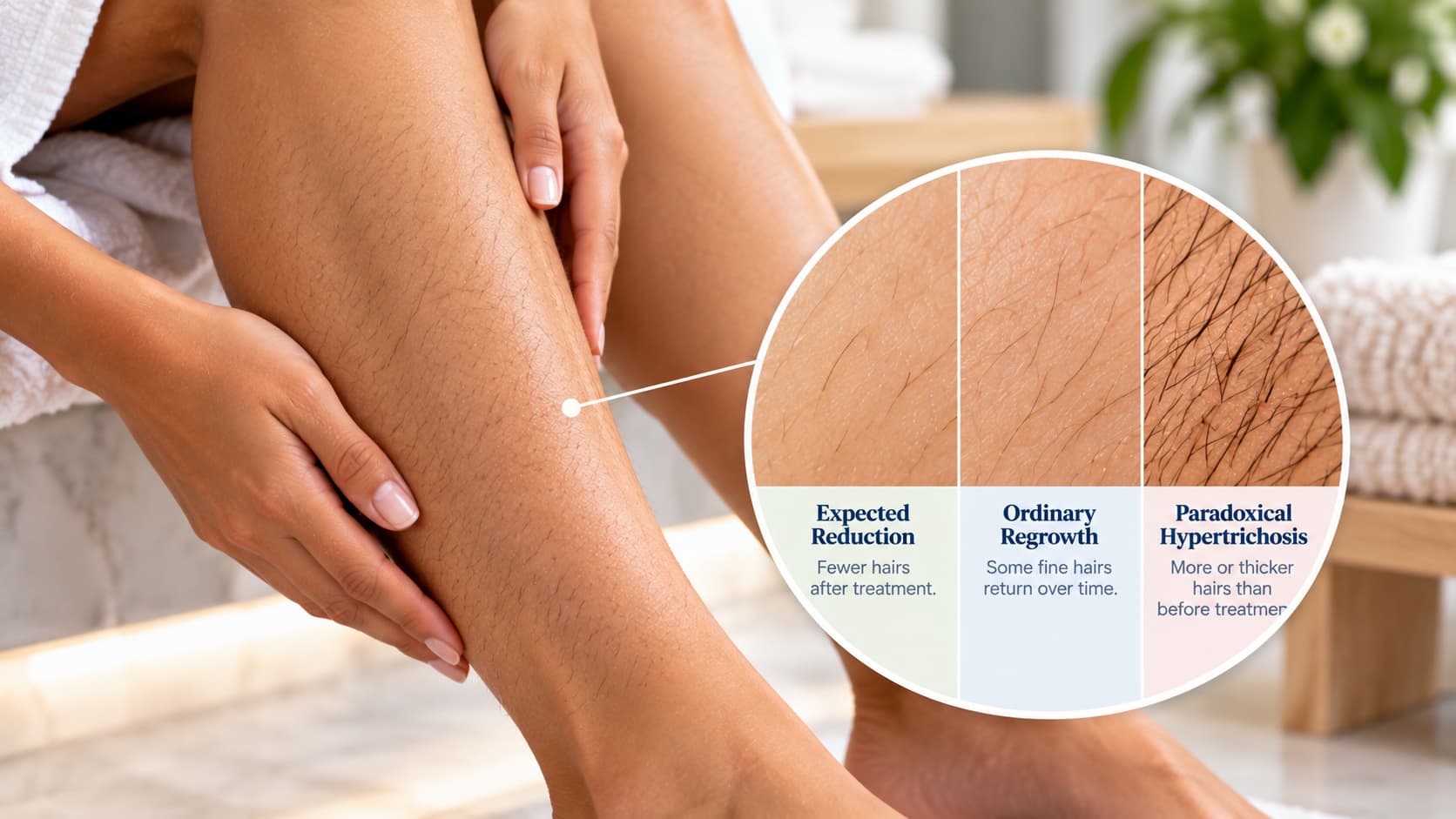
Can laser hair removal make hair grow back worse? Yes, although it is uncommon. Laser hair removal is designed to reduce unwanted hair, but a recognized side effect called paradoxical hypertrichosis can sometimes cause increased hair growth in or near a treated area.
That sounds contradictory, especially when the purpose of treatment is to have less hair, not more.
Fortunately, this reaction is uncommon, and it is not the same as the ordinary regrowth or shedding that occurs during a laser hair removal series.
Understanding the difference can help you recognize what’s expected, what deserves attention, and what questions to ask before starting treatment.
What Is Paradoxical Hypertrichosis?
Paradoxical hypertrichosis is an unexpected increase in hair growth following laser or intense pulsed light (IPL) hair removal.
Instead of reducing hair growth in a particular area, treatment is followed by the appearance of more noticeable hair, sometimes including thicker, darker, or more numerous hairs.
The change may occur within the treated area or in nearby skin.
For example, someone receiving laser hair removal on the face might notice that previously fine, barely visible hairs along the cheeks or jawline become more prominent.
This is different from simply seeing some hairs return after a treatment series.
Paradoxical hypertrichosis refers to an apparent increase compared with the original hair growth, not merely an incomplete reduction.
How Common Is Increased Hair Growth After Laser Hair Removal?
Paradoxical hypertrichosis is considered uncommon, but estimates vary across studies.
A 2021 systematic review and meta-analysis examined studies involving 9,733 patients and estimated an overall prevalence of approximately 3%, with a 95% confidence interval of 1%–6%.
However, there was substantial variation between the included studies. The 3% figure should not be interpreted as a precise prediction of an individual patient’s risk.
The review found that paradoxical hypertrichosis was associated particularly with treatment of the face and neck. In the included studies, it was reported in only approximately 0.08% of cases involving other body areas.
A separate 2024 retrospective study involving 7,381 patients identified increased hair growth in 25 patients, approximately 0.34%.
These different findings illustrate why there isn’t one reliable percentage that applies to every treatment area, patient, or laser setting.
Why Would Laser Hair Removal Cause More Hair to Grow?
Researchers have not established one definitive explanation.
One proposed mechanism is that some hair follicles receive enough heat or inflammatory stimulation to change their behavior, but not enough to produce the intended reduction in hair growth.
Another possibility involves previously fine, lightly visible hairs becoming more noticeable after exposure to laser or light-based treatment.
These remain proposed mechanisms rather than proven explanations for every case.
The important distinction is that paradoxical hypertrichosis is a documented adverse effect, but its exact biological cause is not fully understood.
Where Is Paradoxical Hair Growth Most Likely to Occur?
The face and neck are the most consistently reported locations.
Areas discussed in the medical literature include:
- Cheeks and sideburn areas.
- Jawline and chin.
- Neck.
- Upper arms.
- Upper back.
- Areas around the breasts.
Not every study reports the same pattern. For example, the 2024 retrospective study identified the upper arms and the area around the nipples among its more frequently affected locations.
One practical consideration is that some of these areas contain a mixture of coarse terminal hairs and fine, soft vellus hairs.
Fine hairs are generally less responsive to conventional laser hair removal, which makes careful treatment planning especially important.
Who May Be More Likely to Experience Paradoxical Hypertrichosis?
Research has suggested several possible associations, although not all have been consistently confirmed.
1. Treatment of Fine Facial Hair
Fine facial hair can be difficult to treat effectively because it contains less pigment than coarse, dark hair.
Laser hair removal generally works best when sufficient pigment is present in the hair to absorb the laser energy.
That is one reason treating fine facial peach fuzz deserves more caution than treating dense, coarse hair on the legs or underarms.
2. Certain Skin Types
Some earlier reports suggested an increased risk among patients with darker skin types.
However, the 2021 meta-analysis found insufficient evidence to establish a reliable relationship between skin type and paradoxical hypertrichosis.
The 2024 retrospective study also did not find a significant difference in incidence based on skin type.
Therefore, it would be inaccurate to say that darker skin automatically means someone will develop this reaction.
Skin tone still matters when selecting a laser wavelength and treatment settings because of the separate risks of burns and pigmentation changes.
Read our related article, Can You Get Laser Hair Removal on Dark Skin?, for a more detailed explanation.
3. Hormonal Influences
Hormones can affect facial and body hair growth independently of laser treatment.
For example, androgen-related conditions such as polycystic ovary syndrome (PCOS) may contribute to increased facial hair in some women.
This can make it difficult to distinguish a true laser-associated increase from hair growth that would have occurred because of an underlying hormonal condition.
New or worsening facial hair may deserve a medical evaluation, particularly when accompanied by irregular menstrual cycles, acne, scalp hair thinning, or other signs of hormonal changes.
Hormonal influences should be considered before concluding that laser treatment caused the change.
Does Paradoxical Hypertrichosis Mean the Laser Was Used Incorrectly?
Not necessarily.
Subtherapeutic heating is one proposed explanation, but the development of paradoxical hypertrichosis does not, by itself, prove that a provider used incorrect settings or performed treatment improperly.
The 2021 meta-analysis did not find a significant association between the rate of paradoxical hypertrichosis and the treatment modality or interval between sessions.
Individual studies have reported associations involving specific technologies, but those findings should not be interpreted as proof that one laser completely eliminates the risk.
Appropriate patient selection, realistic expectations, and individualized treatment settings remain important.
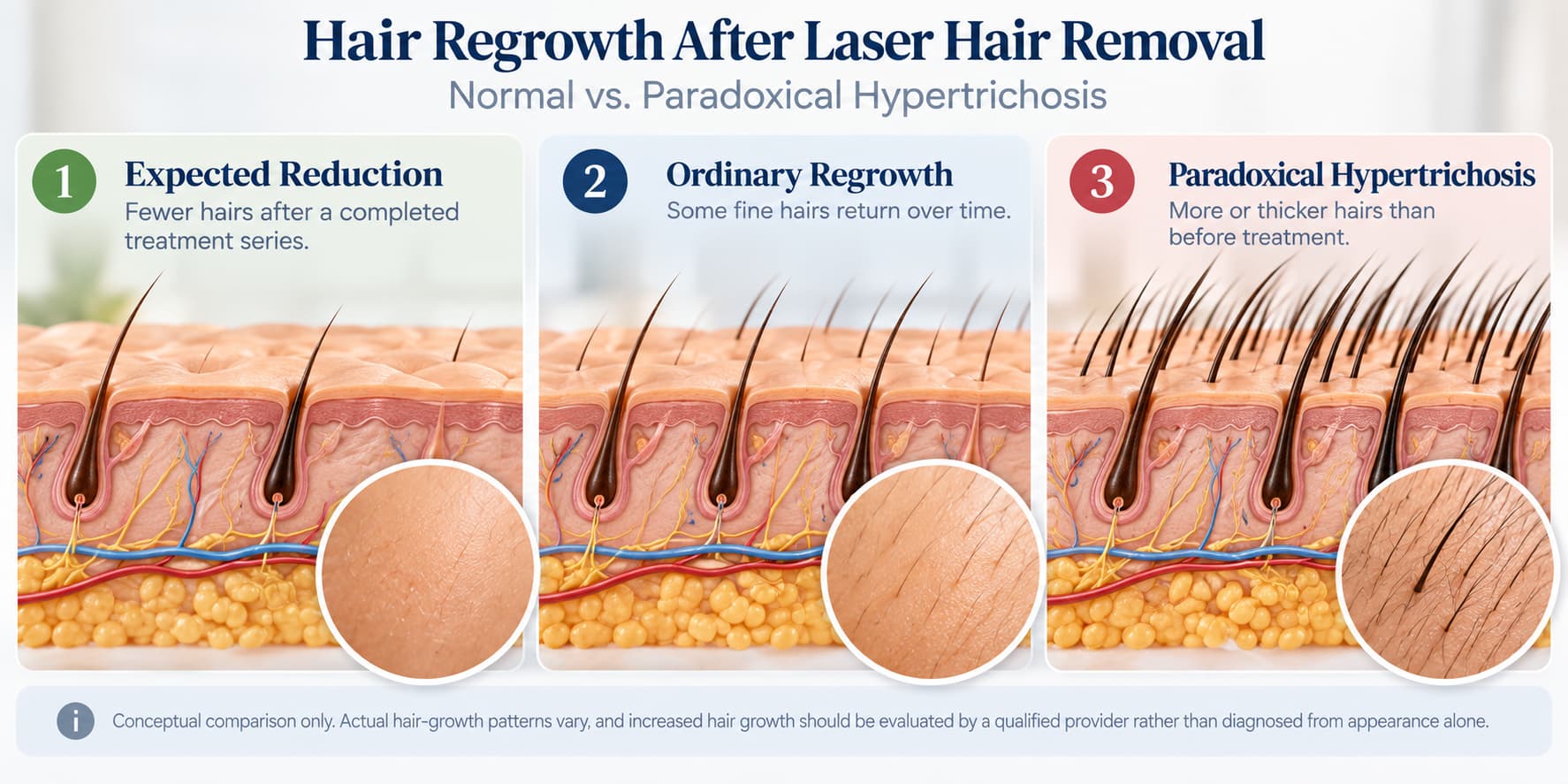
Is Hair Regrowth After Laser Treatment the Same as Paradoxical Hypertrichosis?
No. This is one of the most important distinctions.
Laser hair removal produces progressive hair reduction rather than guaranteed removal of every follicle.
Some regrowth can occur after treatment, particularly in hormonally influenced areas.
Paradoxical hypertrichosis is different because the amount or prominence of hair increases beyond what was present before treatment.
| What You’re Noticing | What It May Mean |
|---|---|
| Hair appears to grow shortly after a session | Previously treated hairs may be moving toward shedding. |
| Some hair remains after several sessions | Not every follicle responds at the same time; additional sessions may be needed. |
| Fine hair returns months or years later | Ordinary regrowth or a need for maintenance may be involved. |
| Previously fine or sparse hair becomes noticeably denser or coarser | Paradoxical hypertrichosis is one possibility and deserves evaluation. |
| New facial hair develops alongside hormonal symptoms | An underlying hormonal cause should also be considered. |
For more about expected long-term results, see Is Laser Hair Removal Permanent? What Permanent Hair Reduction Really Means.
Why Does Hair Sometimes Look Worse Before It Gets Better?
After a laser hair removal appointment, treated hairs do not always disappear immediately.
They may remain visible and gradually shed over the following days or weeks.
During this period, the hairs can appear to be growing even though some are being released from the follicles.
Additionally, hair follicles cycle through different growth phases. A single session cannot effectively target every hair at once.
That is why a series of appointments is generally needed.
If you are early in your treatment series and still seeing hair, it does not automatically mean paradoxical hypertrichosis has occurred.
Our article How Many Laser Hair Removal Sessions Do You Need? explains this process in more detail.
Can Paradoxical Hypertrichosis Be Treated?
In some cases, yes.
Published studies have reported improvement with additional appropriately selected laser treatments.
The 2021 systematic review found that paradoxical hypertrichosis gradually improved with continued treatment in three of the four studies that evaluated this outcome.
However, this does not mean everyone should automatically continue the same treatment plan.
The appropriate next step depends on the affected area, hair characteristics, skin type, previous treatment parameters, and whether another condition may be contributing to the hair growth.
Options may include:
- Reassessing whether the hairs are suitable targets for laser treatment.
- Reviewing the laser wavelength and treatment approach.
- Considering further laser treatment under appropriate clinical supervision.
- Discussing electrolysis when individual hairs are not good laser candidates.
- Evaluating possible hormonal contributors when indicated.
There is no universal correction that guarantees resolution.
What Should You Do If Hair Growth Increases After Laser Hair Removal?
If you believe your hair is becoming denser, darker, or coarser after treatment, contact your provider before simply scheduling more sessions.
It can help to:
- Document the change. Take clear photographs under similar lighting conditions.
- Compare with your starting point. Baseline photographs can help distinguish increased growth from ordinary regrowth.
- Identify the affected area. Note whether the change is within the treated area or along its borders.
- Review your treatment history. Include the number of sessions, timing, and technology used if known.
- Discuss other possible causes. Hormonal changes, medications, and underlying conditions may affect hair growth.
Don’t assume that every increase in visible hair was caused by the laser, but don’t dismiss a persistent change either.
Can You Reduce the Risk of Paradoxical Hypertrichosis?
No approach has been proven to eliminate the risk entirely.
However, thoughtful treatment planning can help avoid treating hair that is unlikely to respond well.
Before beginning laser hair removal, it is reasonable to ask:
- Is my hair coarse and pigmented enough to be a good laser target?
- Is this treatment area associated with a higher risk of paradoxical growth?
- Which laser wavelength is appropriate for my skin and hair?
- Are there hormonal or medical factors affecting my hair growth?
- What results should I realistically expect?
- What happens if my hair growth doesn’t respond as expected?
A consultation should be about determining whether laser treatment is appropriate—not simply treating every area where hair is visible.
Does the Candela GentleMax Pro Prevent Paradoxical Hypertrichosis?
No laser system can be said to eliminate this complication.
At Vital Glow Men’s & Women’s Health, we use the Candela GentleMax Pro, which offers two laser wavelengths: 755 nm Alexandrite and 1064 nm Nd:YAG.
These wavelengths provide treatment options for appropriately selected patients with different skin and hair characteristics.
The system also includes a Dynamic Cooling Device to help protect the skin during treatment.
However, having a dual-wavelength laser or a cooling system does not guarantee that paradoxical hypertrichosis cannot occur.
The more important questions are whether a particular area should be treated, whether the hair is suitable for laser reduction, and how the treatment is individualized.
Should You Avoid Laser Hair Removal Because of This Risk?
For most appropriate candidates, paradoxical hypertrichosis is not a reason to rule out laser hair removal altogether.
Laser treatment can produce meaningful long-term hair reduction, especially for suitable coarse, pigmented hair.
But the risk deserves discussion when treating areas with fine hair, particularly the face and neck.
Someone considering laser treatment for coarse underarm hair may face a different risk profile from someone considering treatment for fine cheek hair.
Understanding those differences is more useful than treating all laser hair removal as equally risky.
Frequently Asked Questions
Can laser hair removal stimulate new hair growth?
Yes, an uncommon reaction called paradoxical hypertrichosis can cause increased hair growth in or near a treated area. The exact mechanism remains uncertain.
How rare is paradoxical hypertrichosis?
A 2021 systematic review estimated an overall prevalence of approximately 3%, but rates varied substantially across studies. The reaction was much less frequently reported outside the face and neck.
Can laser hair removal make facial hair thicker?
It can happen in uncommon cases, particularly in areas containing fine facial hair. However, increased facial hair can also have hormonal causes, so an assessment is important.
Does paradoxical hypertrichosis go away?
Some published cases improve with additional appropriately selected treatment. Resolution is not guaranteed, and the next step should be individualized.
Can laser hair removal cause more hair on the legs?
Paradoxical growth has been reported outside the face and neck, but it appears substantially less common in those areas. Ordinary regrowth is a more common explanation for hair remaining after treatment.
Is paradoxical hypertrichosis more common with Alexandrite or Nd:YAG lasers?
Individual studies have reported different findings, but available research does not establish a universally risk-free wavelength. A 2021 meta-analysis did not identify treatment modality as a significant predictor.
Should I continue laser sessions if I notice more hair?
Not without discussing the change with your provider. Some cases improve with further treatment, but the hair growth pattern and possible causes should be assessed before deciding what to do next.
Laser Hair Removal Should Begin With the Right Assessment
Laser hair removal is intended to reduce unwanted hair, and many patients experience lasting benefits.
But paradoxical hypertrichosis is a real, uncommon complication that deserves an accurate explanation.
The key is understanding that not all hair is equally suitable for laser treatment. Coarse, dark hair often responds differently from fine facial hair, and individual medical factors may influence results.
At Vital Glow Men’s & Women’s Health in Columbia, SC, we believe patients should understand both the potential benefits and limitations of their treatment options.
If you’re considering treatment, learn more about our Candela GentleMax Pro laser hair removal services.
The right plan starts with a conversation, not pressure.
Medical References
- Paradoxical Hypertrichosis Associated with Laser and Light Therapy for Hair Removal: A Systematic Review and Meta-analysis (2021).
- What Are the Factors That Induce Paradoxical Hypertrichosis After Laser Hair Removal? (2024).
- Paradoxical Hypertrichosis After Laser Therapy: A Review (2010).
- Endocrine Society Clinical Practice Guideline: Evaluation and Treatment of Hirsutism in Premenopausal Women.
Medically reviewed by Candace Danbury, MSN, APRN, FNP-BC.