
Is laser hair removal better than waxing? If your goal is temporary smoothness with a lower initial cost, waxing may be a good fit. If you're looking for long-term hair reduction and less ongoing maintenance, laser hair removal may be the better investment. Both methods remove unwanted hair, but they work very differently. Waxing pulls …


Is laser hair removal better than waxing? If your goal is temporary smoothness with a lower initial cost, waxing may be a good fit. If you’re looking for long-term hair reduction and less ongoing maintenance, laser hair removal may be the better investment.
Both methods remove unwanted hair, but they work very differently.
Waxing pulls hair out from the root, leaving skin smooth until the hair grows back. Laser hair removal uses light energy to damage hair follicles and progressively reduce future hair growth.
The biggest difference isn’t necessarily how smooth your skin feels immediately afterward. It’s how often you’ll need to repeat the process over the coming months and years.
Here’s how the two methods compare in cost, discomfort, results, maintenance, and ingrown hairs.
Laser Hair Removal vs. Waxing: What’s the Difference?
Waxing is a temporary hair-removal method. Warm or cold wax adheres to the hair, and removing the wax pulls the hair from its follicle.
Because the follicle remains capable of producing hair, regrowth is expected. The American Academy of Dermatology explains that waxing results generally last a few weeks or longer.
Laser hair removal works differently.
The laser targets pigment in the hair, converting light energy into heat that damages structures involved in hair growth.
Because hairs grow in different cycles, multiple laser treatments are generally necessary to achieve substantial reduction.
Once the initial series is complete, many people experience significantly less hair growth for months or years, although some regrowth and maintenance treatments are possible.
Laser Hair Removal vs. Waxing: Side-by-Side Comparison
| Factor | Waxing | Laser Hair Removal |
|---|---|---|
| How it works | Pulls hair out from the root | Uses laser energy to reduce future hair growth |
| Results | Temporary smoothness | Progressive, long-term hair reduction |
| Maintenance | Regular repeat appointments | Initial treatment series; occasional maintenance may be needed |
| Discomfort | Quick pulling sensation | Brief heat or rubber-band-like snaps |
| Ingrown hairs | Can contribute to ingrown hairs | May reduce recurring hair-related bumps |
| Hair color | Works on many hair colors | Generally most effective on dark, pigmented hair |
| Initial cost | Usually lower per visit | Usually higher upfront |
| Long-term cost | Continues with repeat waxing | May decrease as hair growth is reduced |
Neither method is automatically right for everyone. Your priorities, hair characteristics, skin, budget, and desired results all matter.
Which Costs More: Laser Hair Removal or Waxing?
Waxing generally costs less at an individual appointment, while laser hair removal usually requires a larger initial investment.
But comparing the price of one wax with one laser session doesn’t tell the whole story.
Waxing is an ongoing expense because the hair grows back. If you continue waxing regularly, you continue paying for appointments.
Laser hair removal involves a treatment series designed to produce long-term reduction, potentially reducing the number of hair-removal appointments needed in the future.
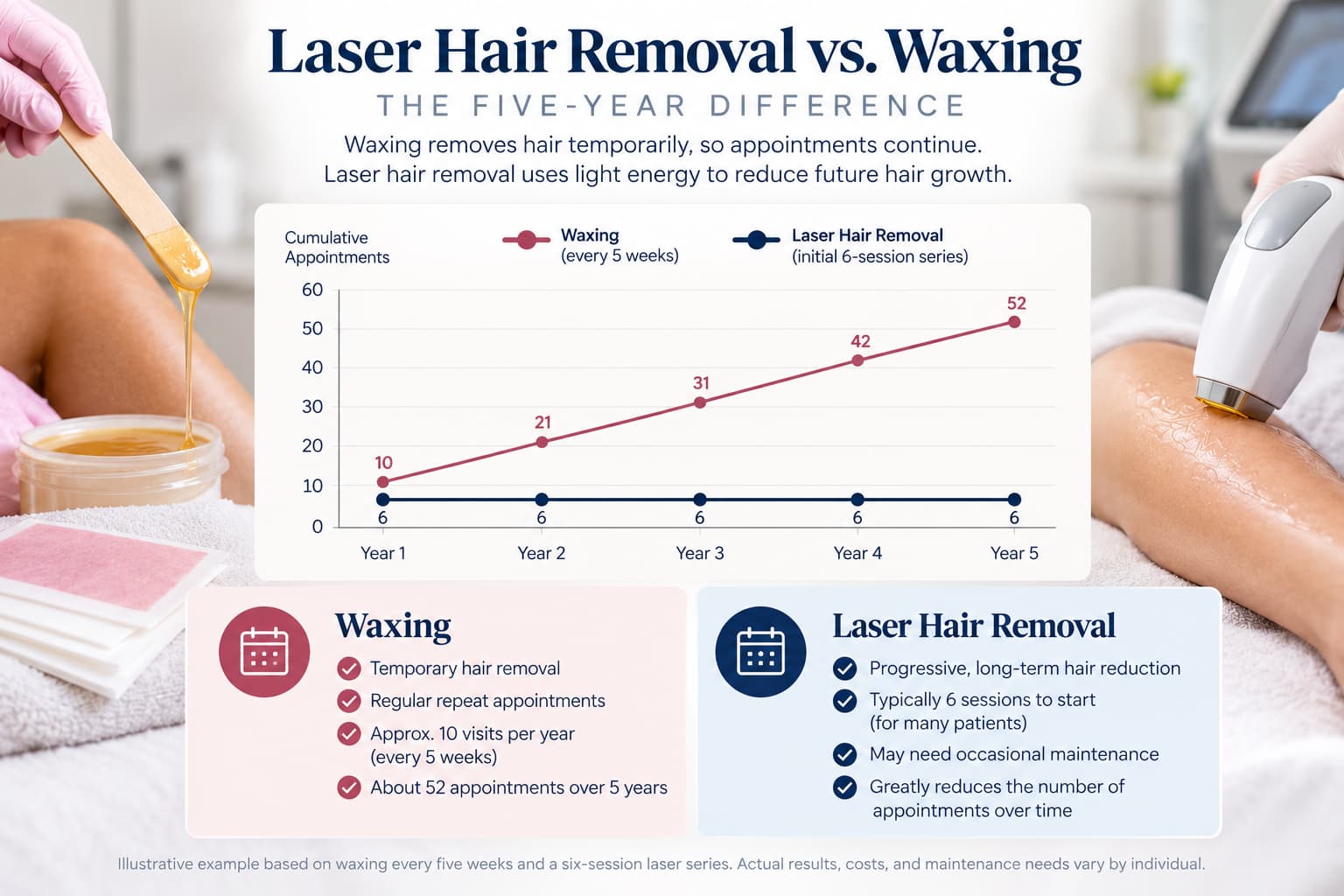
How Much Can Waxing Cost Over Five Years?
Consider someone who pays $65 for a waxing appointment every five weeks.
That’s approximately 10 appointments per year, or about $650 annually.
Over five years, that would be approximately $3,250, before tips, travel costs, or price increases.
These numbers are an illustration, not a universal waxing price or a prediction of what any individual will spend.
The actual cost depends on the area, provider, appointment frequency, and whether you continue waxing consistently.
How Does Laser Hair Removal Compare Financially?
Laser hair removal pricing depends on the treatment area and whether you purchase individual sessions or a treatment package.
The upfront investment may be higher, but the purpose is different: rather than repeatedly removing hair that grows back, you’re working toward long-term hair reduction.
For some people, that can make laser hair removal less expensive over several years. For others, especially those who wax infrequently or require substantial laser maintenance, the financial advantage may be smaller.
The fairest comparison is the total expected cost over time, including the initial laser series and any maintenance—not just the price of the first appointment.
Which Hurts More: Waxing or Laser Hair Removal?
Both can be uncomfortable, but the sensations are different.
Waxing removes multiple hairs at once, creating a brief pulling or stinging sensation.
Laser hair removal delivers a series of quick pulses that many patients describe as warm pinpricks or rubber-band snaps.
The Mayo Clinic describes this snapping sensation and explains that cooling devices may help protect the skin and improve comfort.
At Vital Glow, our Candela GentleMax Pro incorporates a Dynamic Cooling Device (DCD) to help protect the skin during treatment.
There isn’t a reliable answer that laser always hurts less than waxing—or vice versa.
Individual sensitivity, treatment area, hair density, and the technique being used all influence discomfort.
For more information, see Does Laser Hair Removal Hurt? What Treatment Actually Feels Like.
Which Lasts Longer: Laser Hair Removal or Waxing?
This is where the difference becomes particularly meaningful.
Waxing removes existing hair, but it does not reliably produce permanent hair reduction. New hair growth is expected, which is why appointments must be repeated.
Laser hair removal aims to reduce the follicle’s ability to produce hair.
According to the American Academy of Dermatology, many patients remain hair-free for months or even years after laser treatment. When hair returns, there is often less of it, and it tends to be finer and lighter.
That doesn’t mean laser hair removal guarantees every hair will disappear forever.
Some patients need occasional maintenance treatments, and hormonally influenced areas may require additional attention.
We explain this distinction in Is Laser Hair Removal Permanent?.
Is Laser Hair Removal Better Than Waxing for Ingrown Hairs?
For people who repeatedly develop ingrown hairs, laser hair removal may offer an important advantage.
Waxing removes hair from the root, but new hair eventually grows. Some regrowing hairs can become trapped beneath the skin or curve back into it.
Laser treatment reduces hair growth itself, which may reduce the opportunities for recurring ingrown hairs and razor bumps.
However, laser hair removal isn’t an instant cure for every existing bump, and not every inflamed follicle is caused by an ingrown hair.
If ingrown hairs are one of your main reasons for considering laser treatment, read Laser Hair Removal for Razor Bumps and Ingrown Hairs: Does It Help?.
Laser Hair Removal vs. Brazilian Waxing
The Brazilian area is one of the places where patients often compare these methods.
Brazilian waxing removes hair temporarily, so maintaining the result requires repeat appointments.
Brazilian laser hair removal is intended to progressively reduce hair growth in the treated area over multiple sessions.
There are several practical differences to consider:
- Waxing: Lower initial expense, immediate hair removal, and ongoing repeat visits.
- Laser: Higher initial investment, gradual reduction, and potentially less ongoing maintenance.
- Comfort: Both can be uncomfortable, particularly in sensitive areas.
- Hair characteristics: Waxing can remove light-colored hairs that conventional hair-removal lasers may not effectively target.
If you currently get a Brazilian wax regularly, consider what you spend over an entire year rather than comparing the price of a single wax with a laser package.
Laser Hair Removal vs. Waxing for Legs and Underarms
For larger areas such as the legs, convenience may be a major consideration.
Waxing removes hair temporarily, but appointments must be repeated as hair regrows.
Laser treatment requires an initial series, with the potential for significantly reduced maintenance afterward.
Underarms are another area where the difference can be noticeable because some people shave or otherwise remove underarm hair frequently.
Reducing hair growth may make daily grooming easier, although the extent of reduction varies.
Which Is Better for Sensitive Skin?
Neither method is automatically safer for everyone with sensitive skin.
Waxing can cause temporary redness, irritation, burns from overheated wax, or skin injury in certain circumstances.
The American Academy of Dermatology warns that waxing may be inappropriate when using certain medications or topical treatments, including isotretinoin and tretinoin, because of the risk of skin injury.
Laser hair removal also has risks, including temporary redness, swelling, burns, and pigment changes.
The appropriate method depends on your skin condition, medications, hair characteristics, and treatment history.
If you experience frequent irritation from either method, discuss it with a qualified provider rather than assuming that more aggressive treatment is the answer.
Can People With Dark Skin Choose Laser Instead of Waxing?
Yes. Laser hair removal can be appropriate for many people with darker skin tones.
However, the wavelength and treatment settings are particularly important because laser energy interacts with melanin in both the hair and surrounding skin.
At Vital Glow, the Candela GentleMax Pro combines 755 nm Alexandrite and 1064 nm Nd:YAG wavelengths.
The 1064 nm Nd:YAG wavelength is commonly used for appropriately selected darker skin types because it is less strongly absorbed by epidermal melanin.
That doesn’t make every patient a candidate or eliminate the risk of adverse effects.
For a fuller explanation, see Can You Get Laser Hair Removal on Dark Skin?.
Can You Switch From Waxing to Laser Hair Removal?
Yes, but you need to stop waxing before starting laser treatment.
Laser hair removal depends on pigmented hair being present within the follicle.
Waxing removes that hair from the root, which can interfere with the laser’s ability to target it.
Mayo Clinic recommends avoiding waxing, plucking, and electrolysis for at least four weeks before laser hair removal.
Shaving is generally allowed because it removes hair above the skin while leaving the hair within the follicle.
For preparation details, see How to Prepare for Laser Hair Removal.
How Many Laser Sessions Would Replace Regular Waxing?
There isn’t a one-to-one conversion between waxing appointments and laser sessions.
Waxing appointments repeatedly remove regrown hair. Laser sessions are spaced to target hair across different growth cycles and produce cumulative reduction.
Mayo Clinic describes an initial laser treatment course of approximately four to eight sessions for many patients, although individual needs vary.
Some patients require additional sessions or maintenance treatments.
See How Many Laser Hair Removal Sessions Do You Need? for a more detailed explanation.
When Might Waxing Be the Better Choice?
Laser hair removal isn’t the best option for every situation.
Waxing may be preferable if:
- You want temporary hair removal rather than long-term reduction.
- You have light-colored hair that is unlikely to respond well to conventional hair-removal lasers.
- You don’t want to commit to a treatment series.
- You prefer a smaller immediate expense and don’t mind regular appointments.
- You aren’t currently a suitable candidate for laser treatment.
There is nothing wrong with choosing waxing if it meets your needs.
The purpose of comparing these methods is to understand their tradeoffs rather than assume one is universally superior.
When Might Laser Hair Removal Be the Better Choice?
Laser hair removal may be more appealing if:
- You’re tired of repeated waxing appointments.
- You want long-term reduction rather than temporary hair removal.
- You frequently develop ingrown hairs or razor bumps.
- You want to reduce how often you shave or wax.
- You’re comfortable with an initial treatment series and possible future maintenance.
- Your skin and hair characteristics make you a suitable candidate.
For many patients, the decision comes down to how much they value reducing the ongoing effort of hair removal.
Frequently Asked Questions
Is laser hair removal cheaper than waxing in the long run?
It can be, particularly for someone who pays for regular waxing over several years. However, the answer depends on the treatment area, waxing frequency, laser package cost, results, and maintenance needs. Laser hair removal isn’t guaranteed to be less expensive for everyone.
Does laser hair removal hurt more than waxing?
Not necessarily. Waxing creates a pulling sensation as hairs are removed, while laser hair removal produces brief snapping or warm pinprick sensations. Individual experiences vary considerably.
Is laser hair removal better than a Brazilian wax?
Laser hair removal may be preferable if your goal is long-term reduction and less frequent maintenance. Brazilian waxing may be preferable if you want temporary results without committing to a laser treatment series.
Does waxing eventually stop hair growth?
Waxing is not a reliable method of permanent hair reduction. Although repeated waxing may change how hair appears for some people, regrowth is generally expected and repeat appointments are needed.
How long after waxing can I start laser hair removal?
Mayo Clinic recommends stopping waxing, plucking, and electrolysis at least four weeks before laser treatment. Your provider may give additional instructions based on the area and hair growth.
Does laser hair removal prevent ingrown hairs better than waxing?
Laser hair removal can reduce recurring ingrown hairs by decreasing hair growth itself. Waxing removes existing hair temporarily but doesn’t prevent future regrowth or all ingrown hairs.
Can I wax between laser hair removal sessions?
Generally, no. Waxing removes the hair from the follicle that the laser needs to target. Shaving is usually the preferred method of managing hair between laser appointments, following your provider’s instructions.
The Real Difference Is What Happens After the Appointment
Both waxing and laser hair removal can leave skin feeling smoother, but they have very different long-term goals.
Waxing removes hair temporarily. Laser hair removal aims to reduce how much hair grows back.
If you’re satisfied with regular waxing, there’s no need to change simply because another option exists.
But if you’re tired of scheduling appointments, dealing with repeated regrowth, or managing shaving and waxing-related irritation, laser hair removal may be worth considering.
At Vital Glow Men’s & Women’s Health, we offer both waxing and laser hair removal in Columbia, SC. Our laser hair removal treatments use the dual-wavelength Candela GentleMax Pro, allowing us to evaluate treatment options for a broad range of skin tones and hair characteristics.
The right choice depends on your goals, skin, hair, budget, and how much maintenance you’re comfortable with.
Explore Laser Hair Removal at Vital Glow
Medically reviewed by Candace Danbury, MSN, APRN, FNP-BC.