What should you avoid after laser hair removal? The most important precautions are to protect treated skin from the sun, avoid unnecessary heat and irritation, and follow the aftercare instructions provided by your laser professional. For the first 24–48 hours, that often means postponing strenuous workouts, hot tubs, saunas, very hot showers, and harsh skincare …


What should you avoid after laser hair removal? The most important precautions are to protect treated skin from the sun, avoid unnecessary heat and irritation, and follow the aftercare instructions provided by your laser professional. For the first 24–48 hours, that often means postponing strenuous workouts, hot tubs, saunas, very hot showers, and harsh skincare products—especially if your skin is still red or sensitive.
Laser hair removal typically involves little downtime, but that doesn’t mean your skin needs no attention afterward.
Mild redness, swelling around hair follicles, and temporary sensitivity are common. How you care for your skin during this period can affect your comfort and help reduce avoidable irritation.
Whether you’re treating your legs, underarms, bikini area, face, or another part of your body, here’s what to expect after your appointment and how to care for the treated area.
What Happens to Your Skin After Laser Hair Removal?
Laser hair removal uses concentrated light energy to heat pigmented hair and damage structures involved in hair growth.
Although the treatment targets hair follicles, the surrounding skin may temporarily react to that heat.
According to the Mayo Clinic, common temporary effects include redness, swelling, and discomfort. These reactions generally improve within hours, although they may last longer for some patients.
You might notice:
- Mild redness resembling a light sunburn.
- Small raised bumps around treated follicles.
- A warm or slightly tender sensation.
- Temporary sensitivity when clothing rubs against the area.
These reactions don’t necessarily indicate a problem. However, severe or worsening pain, blistering, significant burns, or unexpected skin changes should be evaluated promptly.
Laser Hair Removal Aftercare: What to Avoid
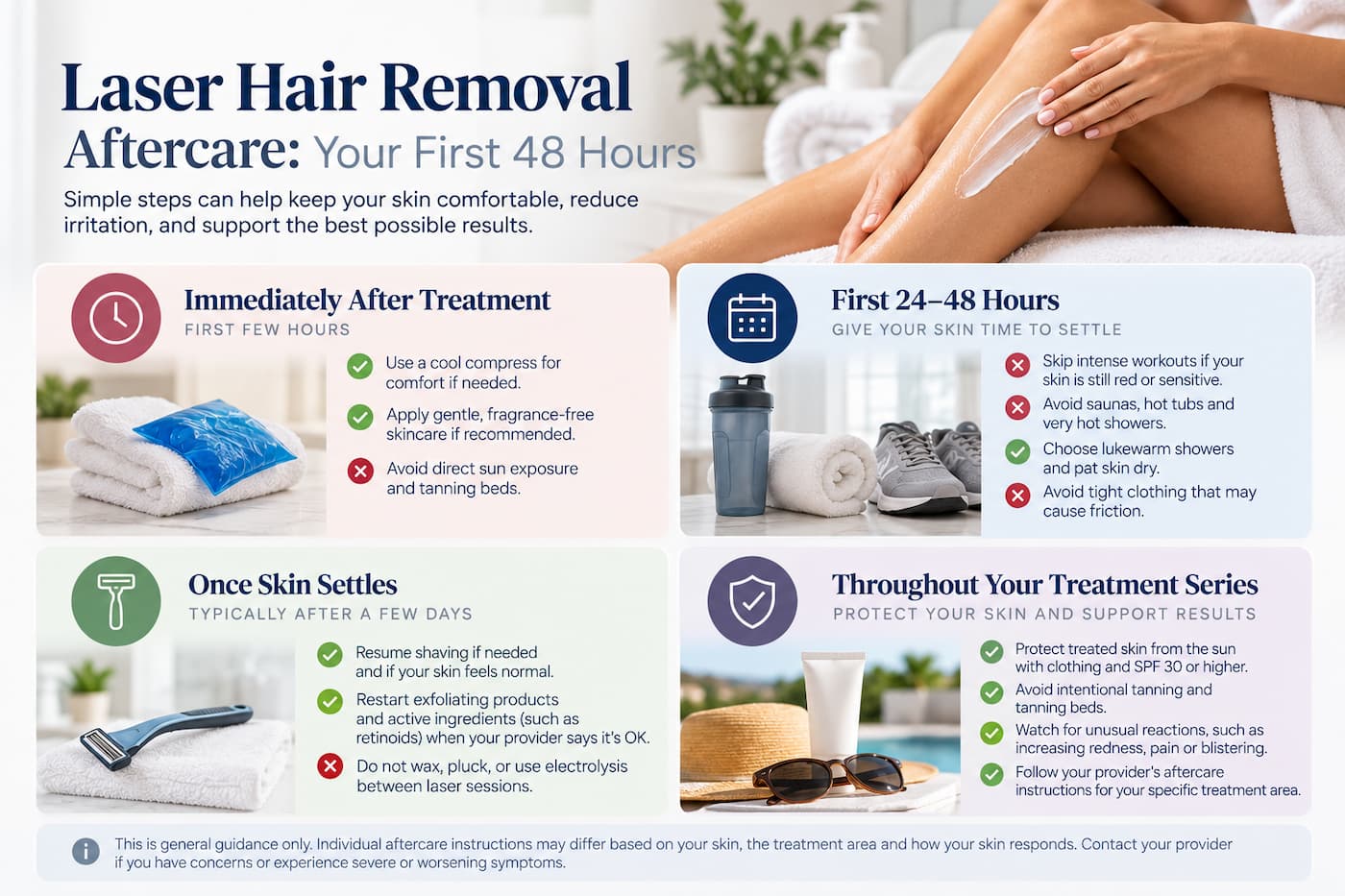
Aftercare recommendations vary depending on the treatment area, skin type, settings used, and how your skin responds.
The following precautions are common starting points, but your treating provider’s specific instructions should take priority.
| Activity or Product | General Aftercare Guidance |
|---|---|
| Direct sun exposure | Protect treated skin throughout the treatment series and afterward. Avoid tanning. |
| Strenuous exercise | Consider waiting 24–48 hours, particularly if the skin remains warm, red, or irritated. |
| Hot showers, saunas, and hot tubs | Avoid excessive heat while the skin is sensitive, commonly for the first 24–48 hours. |
| Scrubs and exfoliating acids | Pause until redness and sensitivity have resolved and your provider approves restarting. |
| Waxing and plucking | Avoid throughout the laser treatment series because these methods remove the hair the laser needs to target. |
| Shaving | Usually permitted between sessions once the skin has settled; avoid shaving irritated skin. |
| Fragranced or irritating products | Use gentle skincare while the area recovers. |
Can You Exercise After Laser Hair Removal?
Many people can return to normal daily activities immediately after laser hair removal, but intense exercise deserves more consideration.
Working out raises body temperature and often involves sweating, friction, and tight clothing. Those factors may make freshly treated skin feel more irritated.
For that reason, providers commonly recommend avoiding strenuous exercise for approximately 24 hours, sometimes extending to 48 hours if the skin remains sensitive.
For example:
- After underarm treatment: Sweat and repetitive arm movement may irritate the area.
- After bikini or Brazilian treatment: Tight leggings, cycling, and friction may increase discomfort.
- After leg treatment: Running or prolonged exercise in tight clothing may aggravate temporary sensitivity.
A gentle walk may be comfortable, but don’t force activity if the treated area feels hot, tender, or irritated.
There isn’t a universal exercise restriction that applies to every patient. Follow the instructions from your treating provider and use your skin’s response as a guide.
Can You Shower After Laser Hair Removal?
Yes. Showering is generally possible after laser hair removal, but keep the water comfortably cool or lukewarm if your skin is sensitive.
Very hot water can increase warmth and discomfort in a recently treated area.
During the initial recovery period:
- Choose a lukewarm rather than steaming-hot shower.
- Use a mild cleanser.
- Avoid rough washcloths, loofahs, and vigorous scrubbing.
- Pat the skin dry instead of rubbing.
- Apply a gentle moisturizer if recommended by your provider.
Once your skin has returned to normal, you can generally resume your usual shower routine.
How Long Should You Avoid Sun Exposure After Laser Hair Removal?
Sun protection is one of the most important parts of laser hair removal aftercare.
Recently treated skin may be more vulnerable to irritation and pigment changes, and tanning can complicate future treatments.
The American Academy of Dermatology recommends protecting treated skin from the sun and avoiding tanning beds.
Instead of thinking about sun protection as something you do for only a day or two, consider it part of your entire laser treatment plan.
Practical precautions include:
- Avoid intentional tanning and tanning beds.
- Limit direct sun exposure to recently treated areas.
- Wear protective clothing when practical.
- Use broad-spectrum, water-resistant SPF 30 or higher on exposed skin, following your provider’s instructions.
- Tell your provider about any recent sunburn or tanning before your next session.
This is especially relevant in Columbia, South Carolina, where outdoor activities, lake days, and warm weather can make sun exposure a regular part of life.
If you have a beach trip or outdoor vacation planned, discuss the timing of your laser sessions beforehand.
Can You Use Sunscreen Immediately After Laser Hair Removal?
Sun protection is important, but the best way to protect freshly treated skin is often to avoid direct exposure in the first place.
If the treated area will be exposed, ask your provider which sunscreen is appropriate and when to apply it.
A gentle, fragrance-free mineral sunscreen may be better tolerated by some people with sensitive skin, but individual reactions vary.
Don’t apply a product that stings or burns without discussing it with your provider.
When Can You Exfoliate After Laser Hair Removal?
Exfoliating immediately after laser hair removal can aggravate temporary irritation.
It’s generally best to avoid physical scrubs, exfoliating brushes, and strong chemical exfoliants until the treated skin has settled.
Products to discuss with your provider include:
- Glycolic acid and other alpha-hydroxy acids.
- Salicylic acid and other beta-hydroxy acids.
- Retinoids, including tretinoin.
- Exfoliating pads, scrubs, and brushes.
- Strong acne treatments or potentially irritating skincare products.
There is no single restart date that’s appropriate for every product and treatment area.
Once redness and sensitivity have resolved, your provider can advise when to resume your regular skincare routine.
Can You Shave After Laser Hair Removal?
Yes, shaving is generally the preferred way to manage hair between laser appointments.
Unlike waxing or plucking, shaving removes hair above the skin’s surface without pulling it out of the follicle.
However, shaving immediately after treatment may irritate skin that’s still tender.
Wait until redness, swelling, and sensitivity have settled before shaving the area. Use a clean, sharp razor and avoid pressing aggressively against the skin.
If shaving regularly causes razor bumps, discuss alternative shaving techniques or an electric trimmer with your provider.
Our article Laser Hair Removal for Razor Bumps and Ingrown Hairs explains why reducing hair growth may help prevent recurring irritation.
Why Should You Avoid Waxing and Plucking Between Laser Sessions?
Laser hair removal works by targeting pigment within the hair follicle.
Waxing, plucking, and electrolysis remove or disrupt the hair that the laser needs to target.
For this reason, these methods are generally avoided during a laser treatment series.
If you need to remove visible hair between appointments, shaving is usually the better option once your skin has recovered.
We compare the long-term differences in Laser Hair Removal vs. Waxing: Cost, Results, Pain and Maintenance Compared.
What Should You Put on Your Skin After Laser Hair Removal?
Simple, gentle care is usually best.
If the skin feels warm or uncomfortable, a cool compress may help. The Mayo Clinic notes that ice packs can help reduce temporary discomfort after laser treatment.
Always place a clean cloth between a cold pack and your skin rather than applying ice directly.
Depending on the treatment area and your provider’s instructions, you may also be advised to use a gentle, fragrance-free moisturizer.
Avoid experimenting with multiple new products immediately after treatment.
More skincare isn’t necessarily better when the skin is temporarily sensitive.
Is It Normal to Have Red Bumps After Laser Hair Removal?
Small bumps surrounding treated follicles can occur after laser hair removal.
This temporary response is sometimes called perifollicular edema—swelling around individual hair follicles.
It may appear as small raised spots accompanied by mild redness.
These bumps often settle as the skin recovers.
However, bumps that become increasingly painful, spread, develop significant drainage, or are accompanied by fever shouldn’t automatically be assumed to be a normal treatment reaction.
Contact your provider if you’re uncertain about what you’re seeing.
Why Does Hair Look Like It’s Growing Back After Laser Hair Removal?
One of the most confusing parts of laser hair removal recovery is that treated hair may remain visible or appear to grow for a while.
This doesn’t necessarily mean the treatment failed.
After treatment, some hairs gradually shed from the follicles over the following days or weeks.
Because not every follicle is in the same growth phase during an appointment, other hairs may continue growing and require future sessions.
Don’t try to speed up shedding by plucking or waxing the area.
For a closer look at why multiple appointments are necessary, see How Many Laser Hair Removal Sessions Do You Need?.
How Long Does Skin Take to Recover After Laser Hair Removal?
Many patients find that mild redness and swelling improve within several hours.
Some experience sensitivity that lasts into the following day or longer.
Recovery depends on several factors:
- The treatment area and its sensitivity.
- Individual skin characteristics.
- Laser settings and treatment technique.
- Hair density and thickness.
- Recent sun exposure or existing irritation.
More significant reactions require individualized assessment rather than a routine aftercare timeline.
When Should You Contact Your Provider After Laser Hair Removal?
Although mild temporary reactions are common, certain symptoms deserve prompt attention.
Contact your treating provider if you develop:
- Blistering or suspected burns.
- Severe or worsening pain.
- Increasing redness or swelling rather than gradual improvement.
- Significant crusting, drainage, or signs of infection.
- Unexpected darkening or lightening of the skin.
- A reaction that persists longer than your provider advised.
Seek urgent medical care for rapidly spreading redness with fever, severe symptoms, or signs of a serious allergic reaction.
Early evaluation can help determine whether a reaction is expected or needs treatment.
Does Aftercare Affect Laser Hair Removal Results?
Aftercare doesn’t replace appropriate laser settings, correct treatment intervals, or the need for multiple sessions.
But protecting your skin can help reduce avoidable irritation and complications that might delay future appointments.
Good results depend on the entire process: patient selection, appropriate treatment, consistent scheduling, and sensible skin care between visits.
At Vital Glow, we use the Candela GentleMax Pro, which combines 755 nm Alexandrite and 1064 nm Nd:YAG laser wavelengths for appropriately selected skin and hair types.
Its Dynamic Cooling Device helps protect the skin during treatment, but cooling technology does not eliminate the need for proper aftercare.
Frequently Asked Questions About Laser Hair Removal Aftercare
Can I work out the day after laser hair removal?
Many providers recommend waiting approximately 24 hours before strenuous exercise, or longer if the skin remains irritated. Follow your specific aftercare instructions.
Can I take a hot shower after laser hair removal?
It’s generally better to use lukewarm water while your skin is sensitive. Avoid very hot showers until warmth, redness, and irritation have resolved.
Can I go to the beach after laser hair removal?
Direct sun exposure and tanning should be avoided around treatment. If you have a beach trip planned, discuss scheduling and sun protection with your provider before your appointment.
Can I use deodorant after underarm laser hair removal?
If your underarms are irritated, deodorant—particularly fragranced or alcohol-containing products—may sting. Ask your provider when to resume use, and wait until the skin has settled if instructed.
Can I wear makeup after facial laser hair removal?
That depends on your skin’s immediate reaction and your provider’s instructions. Avoid applying makeup over skin that is unusually irritated, blistered, or broken, and use clean applicators when you resume.
Can I use retinol after laser hair removal?
Retinoids can irritate recently treated skin. Ask your provider when to restart them, particularly if you use prescription tretinoin or other active skincare products.
How soon can I shave after laser hair removal?
Shave once the treated skin is no longer red, swollen, or sensitive and your provider says it’s appropriate. Avoid waxing or plucking between sessions.
Is it normal for hair to shed after laser hair removal?
Yes. Treated hairs may gradually shed over the following days or weeks. This process can look like continued growth before the hairs are released.
Good Laser Hair Removal Results Start With Good Skin Care
Laser hair removal aftercare doesn’t have to be complicated.
Protect your skin from the sun, avoid excessive heat and friction while it recovers, keep your skincare gentle, and resist the urge to wax or pluck between appointments.
Most importantly, pay attention to how your skin responds rather than relying on a rigid timeline that may not fit your treatment.
If you’re considering laser hair removal in Columbia, SC, Vital Glow Men’s & Women’s Health can help you understand the treatment process, expected maintenance, and aftercare considerations for your skin and hair.
Learn More About Laser Hair Removal at Vital Glow
The right plan starts with a conversation, not pressure.
Medically reviewed by Candace Danbury, MSN, APRN, FNP-BC.