
Short answer: Most people need a series of laser hair removal treatments rather than a single session. Depending on the treatment area, hair characteristics, skin type, hormones, and individual response, a typical treatment plan may involve roughly 4 to 8 sessions—but there is no single number that's right for everyone. The reason has less to …

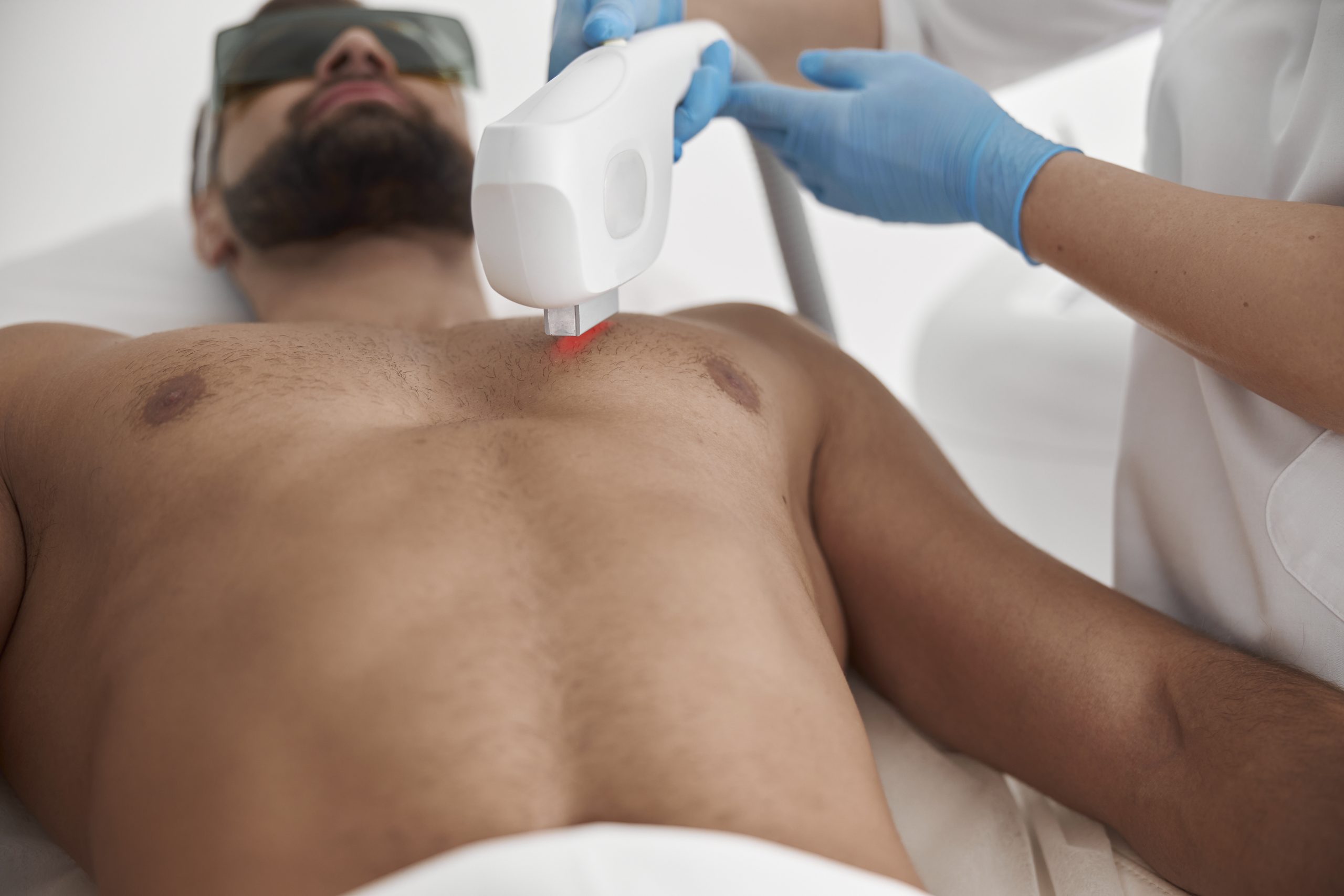
Short answer: Most people need a series of laser hair removal treatments rather than a single session. Depending on the treatment area, hair characteristics, skin type, hormones, and individual response, a typical treatment plan may involve roughly 4 to 8 sessions—but there is no single number that’s right for everyone.
The reason has less to do with the strength of the laser and more to do with something happening beneath your skin:
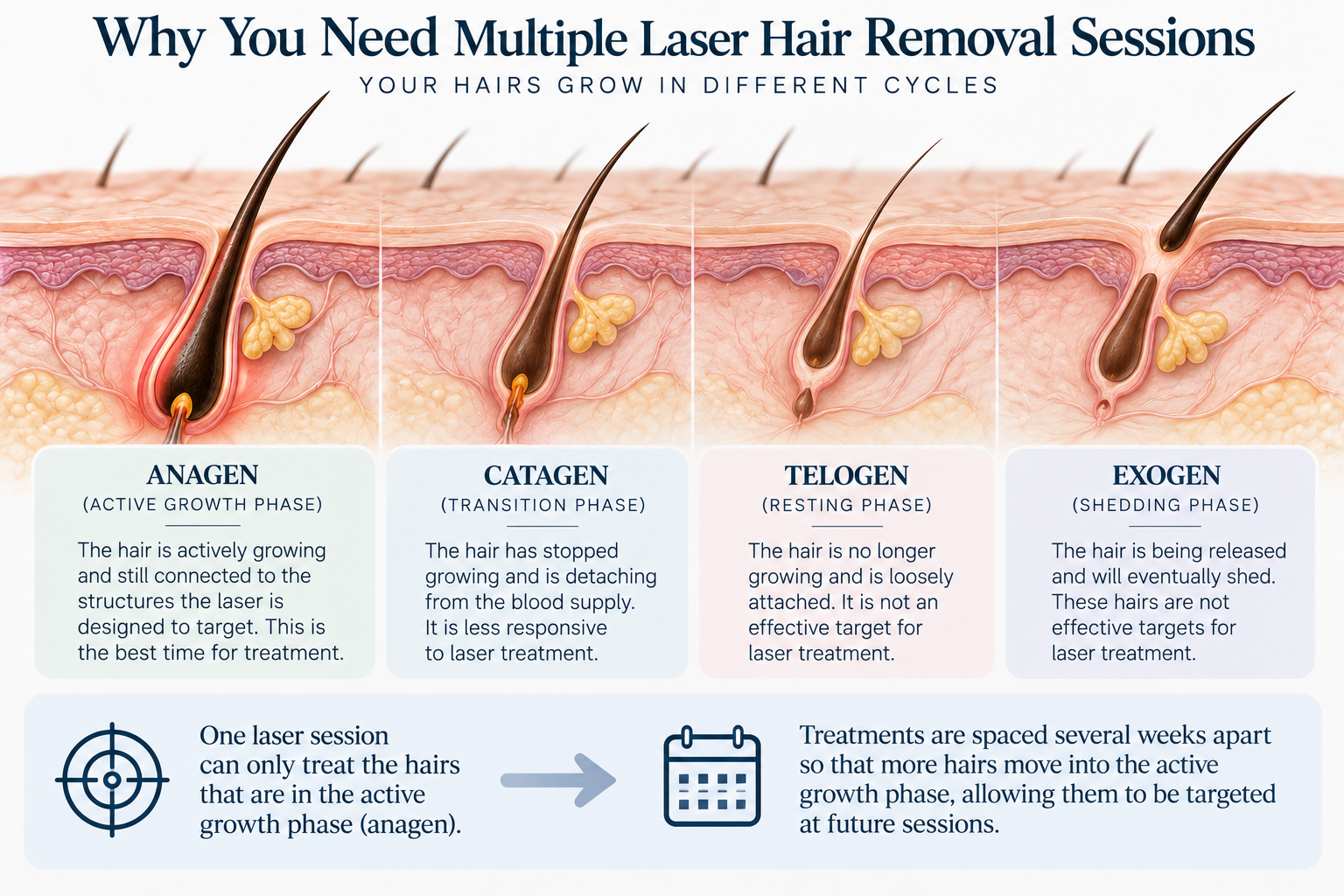
Not all of your hair is actively growing at the same time.
Laser hair removal works most effectively on hairs during the active growth phase. Treatments are therefore spaced apart so that additional hairs can enter that phase and become appropriate targets at later appointments.
At Vital Glow Men’s & Women’s Health in Columbia, SC, we use the Candela GentleMax Pro, a dual-wavelength laser platform that allows treatment parameters to be selected based on factors including skin type and hair characteristics.
How Many Laser Hair Removal Sessions Do Most People Need?
There isn’t one universal treatment count.
The American Academy of Dermatology states that most patients need multiple treatments, commonly reporting a range of 2 to 6 sessions.
Mayo Clinic gives a somewhat broader estimate of approximately 4 to 8 treatments for best results.
Those aren’t conflicting promises. They illustrate an important point about laser hair removal:
Treatment plans vary.
Someone treating coarse, dark underarm hair may respond differently from someone treating hormonally influenced facial hair. Two people treating the same body area may also require different numbers of sessions.
Instead of thinking of laser hair removal as “six sessions and you’re done,” it is more accurate to think of it as a series of treatments followed by reassessment.
Why Doesn’t One Laser Hair Removal Treatment Remove All the Hair?
Because your hairs aren’t synchronized.
Individual hair follicles move through different stages of the hair-growth cycle. At any given appointment, some hairs are actively growing while others are transitioning or resting.
Laser hair removal works by delivering light that is absorbed by pigment in the hair. That energy is converted to heat and damages the follicle responsible for producing the hair.
According to AAD guidance, where a hair is in its growth cycle is one of the factors that influences laser hair removal.
Hair in the active growth phase is the most useful target because it remains connected to the structures that the treatment is intended to damage.
Other follicles may not be effectively targeted during that particular appointment.
Weeks later, a different group of hairs becomes active.
That’s why repeating treatment matters.
What Happens to the Hair After Each Laser Treatment?
The treated hair does not necessarily disappear while you’re sitting in the treatment room.
Mayo Clinic notes that treated hairs typically shed over the following several days to weeks.
Meanwhile, hairs from follicles that weren’t effectively targeted during that session can continue appearing.
This can sometimes make people wonder whether the laser “worked,” especially after an early treatment.
What you’re seeing may actually be a combination of:
- Treated hairs beginning to shed
- Untreated hairs entering an active growth phase
- Hair from follicles that require additional treatment
The cumulative reduction becomes more apparent as additional growth cycles are treated.
How Much Hair Reduction Can You Expect After the First Session?
You may notice a difference after one appointment, but you should not expect one treatment to produce your final result.
The American Academy of Dermatology reports that patients may see approximately 10% to 25% hair reduction after the first treatment, although results vary substantially from person to person.
Factors such as hair thickness, hair color, skin tone, treatment area, laser type, and individual biology all influence response.
This is why evaluating laser hair removal after a single appointment can be misleading.
How Often Should Laser Hair Removal Sessions Be Scheduled?
Laser hair removal sessions are generally separated by several weeks rather than performed back-to-back.
The American Academy of Dermatology notes that many patients can undergo another treatment approximately every 4 to 6 weeks, although the appropriate interval varies by patient and treatment area.
Why wait?
Because the goal is not simply to let your skin recover. The spacing also gives additional follicles time to move into a treatable stage of the hair-growth cycle.
Your treatment schedule may therefore change depending on the area being treated and how your hair responds.
Does the Treatment Area Affect How Many Sessions You Need?
Yes.
Hair does not behave identically everywhere on the body.
Common laser hair removal areas include:
- Underarms
- Bikini area
- Legs
- Back
- Chest
- Neck
- Upper lip
- Chin
- Other areas of unwanted facial or body hair
Different areas can have different hair thicknesses, densities, growth-cycle timing, and hormonal influences.
That means the treatment schedule that works well for underarms may not be identical to the schedule used for facial hair.
Does Hair Color Affect the Number of Treatments?
Hair color matters because laser hair removal relies on pigment.
The laser’s light is absorbed by melanin in the hair, allowing energy to reach and damage the follicle.
Dark, coarse hair generally provides a stronger target because it contains more pigment.
Hair with very little pigment—including white, gray, and some very light blonde or red hair—can be considerably more difficult to treat effectively with conventional laser hair removal.
This is an important distinction because skin tone and hair color are not the same issue.
Modern laser technology allows people across a wide range of skin tones to be treated, but the hair still needs to provide an appropriate target for the laser.
Does Skin Tone Affect Laser Hair Removal?
Skin tone influences how laser hair removal should be performed, but darker skin does not automatically mean someone cannot have laser hair removal.
The American Academy of Dermatology notes that advances in laser technology have expanded treatment to people with darker skin tones, while emphasizing that the procedure must be performed carefully and appropriately.
At Vital Glow, we use the Candela GentleMax Pro.
According to Candela, the GentleMax Pro combines two laser wavelengths:
- 755 nm Alexandrite — optimized for lighter skin types
- 1064 nm Nd:YAG — optimized for darker skin types
Having both wavelengths allows treatment parameters to be selected for a broad range of skin types rather than approaching every patient with the same settings.
We’ll explore this subject in much more detail in an upcoming article about laser hair removal for darker skin tones.
Can Hormones Affect How Many Laser Hair Removal Sessions You Need?
Yes.
Hormones can influence hair growth, particularly in areas such as the face and chin.
This is one reason facial hair can behave differently from hair on areas such as the legs or underarms.
The American Academy of Dermatology specifically notes that hormonal influence can affect the long-term results of laser hair removal on a woman’s face.
If new hairs continue developing because of an underlying hormonal influence, laser treatment can reduce the hairs that are present, but it cannot prevent your body from developing every new hair follicle in the future.
That may mean additional treatments or periodic maintenance are needed.
Does Shaving Between Sessions Make Laser Hair Removal Less Effective?
No. Shaving is generally the preferred method of managing hair between laser treatments.
Shaving cuts the hair at the skin’s surface but leaves the follicle and hair structure beneath the skin available for the laser to target.
Waxing and plucking are different because they pull the hair from the follicle.
Mayo Clinic recommends avoiding waxing, plucking, and electrolysis before laser hair removal and generally recommends shaving shortly before treatment according to your provider’s instructions.
We’ll cover the complete preparation process in our upcoming guide to how to prepare for laser hair removal.
Do You Need Maintenance Treatments After Finishing Your Initial Sessions?
Some people do.
Laser hair removal can produce long-lasting hair reduction, but that does not mean every treated follicle will remain hair-free forever.
The American Academy of Dermatology notes that patients can remain hair-free for months or even years after completing treatment. When hair does regrow, there is often less of it, and the hairs may be finer and lighter.
Periodic maintenance treatments can be used when appropriate.
Hormonal changes can also influence future hair growth, which is one reason maintenance needs vary between individuals.
Does Needing Maintenance Mean Laser Hair Removal Didn’t Work?
No.
There is an important difference between permanent hair reduction and a promise that you will never see another hair in the treated area for the rest of your life.
Laser hair removal is intended to produce a lasting reduction in hair growth.
Some follicles can eventually produce hair again, and hormonal or biological changes can contribute to new growth over time.
We’ll tackle this distinction directly in our next article: Is Laser Hair Removal Permanent? What “Permanent Hair Reduction” Really Means.
Why Might One Person Need More Sessions Than Someone Else?
Several factors can influence how quickly and completely someone responds to laser hair removal, including:
- The area being treated
- Hair color
- Hair thickness and density
- Skin tone
- The laser and wavelength being used
- Where individual hairs are in their growth cycles
- Hormonal influences
- How consistently treatments are completed
- Individual biological response
This is why an exact session count should be viewed as an estimate rather than a guarantee.
What If You Still Have Hair After Six Sessions?
That does not automatically mean treatment has failed.
The more useful questions are:
- Has the overall amount of hair decreased?
- Is the remaining hair finer or less noticeable?
- Are there specific areas that are responding differently?
- Were treatments completed at appropriate intervals?
- Could hormonal factors be contributing to continued growth?
- Does the remaining hair still contain enough pigment to be an effective laser target?
Your provider can assess your response and determine whether additional treatments are likely to be useful.
Simply continuing treatment indefinitely without evaluating why hair remains is not the goal.
Frequently Asked Questions
Is six sessions enough for laser hair removal?
Six sessions is a common treatment-series estimate, but it is not a universal rule. Some people may achieve their desired reduction with fewer treatments, while others may need additional sessions. Treatment area, hair characteristics, skin type, hormones, and individual response all matter.
Can you see results after one laser hair removal session?
Yes. The American Academy of Dermatology reports that some patients may see approximately 10% to 25% reduction after the first treatment. Your final result, however, requires treating hairs across multiple growth cycles.
Why is my hair growing back after laser hair removal?
Seeing hair after an early treatment is expected because only some follicles are effectively targeted during each session. Treated hairs may also take days or weeks to shed. Later in the treatment process, some regrowth may occur and maintenance treatments may be appropriate.
Can I shave between laser hair removal appointments?
Yes. Shaving is generally preferred between treatments because it does not remove the hair from the follicle. Waxing and plucking should generally be avoided because they remove the target the laser needs to treat.
How long should I wait between laser hair removal sessions?
Many laser hair removal treatments are scheduled approximately 4 to 6 weeks apart, but the appropriate interval depends on the treatment area, your response, and your provider’s recommendations.
Will I need laser hair removal forever?
Not necessarily. The goal is long-term hair reduction. After completing an initial treatment series, some people may benefit from occasional maintenance sessions as hair regrows over time.
It’s a Treatment Series, Not a One-Time Procedure
If you’re considering laser hair removal, the most useful expectation is not that a particular number of sessions will eliminate every hair forever.
Instead, laser hair removal works progressively.
Each appointment gives us an opportunity to target hairs that are in an appropriate growth phase, and the reduction builds as additional cycles are treated.
At Vital Glow Men’s & Women’s Health, we offer laser hair removal in Columbia, SC using the Candela GentleMax Pro dual-wavelength laser system.
Your treatment plan should be based on your skin, your hair, the area being treated, and how you actually respond—not simply a predetermined number applied to everyone.
Learn More About Laser Hair Removal at Vital Glow
Medically reviewed by Candace Danbury, MSN, APRN, FNP-BC.